



New EVs Have Gotten Cheaper Since the Federal Electric Vehicle Tax Credit Ended


What Car Shoppers Need to Know
- Since the ending of the federal electric vehicle tax credit in fall 2025, listing prices of new EVs on Cars.com have fallen over 12%.
- Big discounts on new EVs — and even bigger depreciation on used ones — mean it’s a buyers market for shoppers who are curious about purchasing an EV.
Congress’ passing of the One, Big, Beautiful Bill Act in July 2025 set a death date for the federal electric vehicle tax credit. The $7,500 credit that was a major price discount for buyers of EVs ended on Sept. 30, 2025. Some auto industry experts predicted that the ending of the tax credit would cause EV prices to spike. Interestingly, that hasn’t been the case. Cars.com listing data shows how new EV prices ultimately dropped after the ending of the tax credit.
Related: These EVs Are Discontinued for 2026
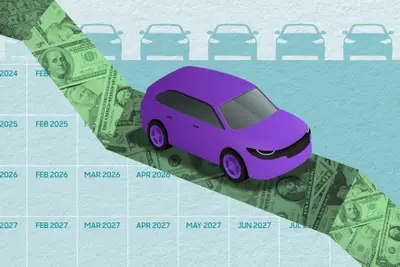
After the tax credit’s expiration, the average listing price of new EVs on Cars.com had already started to fall. From October to November 2025, prices fell 4.4% to an average of just over $63,000. By the end of the year, prices had fallen another 2.6% to an average of $61,551. Now, six months after the ending of the tax credit, the average price of a new EV has plummeted 12.3% to $58,071. Buyers in the market for used EVs are in an even better position: While average prices on used EVs have dropped just 5.3%, the average price is much lower at $35,276.
What’s Driving the Change?
There are a few factors driving the downward trend in EV pricing, but it varies from model to model. Overall, we’re seeing 29.3% more inventory in the $30,000 to $49,000 price range and less inventory of more expensive EVs. The bulk of increased inventory is coming from the availability of new affordable models, including the reintroduced Chevrolet Bolt, redesigned Toyota bZ and redesigned Subaru Solterra, but also more Honda Prologues are being listed in this price range.
EV Inventory Changes in the $30,000-$49,000 Price Range (Oct. 2025-March 2026)
| Model | October 2025 Inventory (Cars) | March 2026 Inventory (Cars) | Inventory % Change | Average Listing Price in $30,000-$49,000 Range |
| 2026 Toyota bZ | 540 | 4,348 | Up 705.2% | $40,517 |
| 2027 Chevrolet Bolt | 0 | 2,022 | New | $33,491 |
| 2026 Subaru Solterra | 84 | 1,919 | Up 2184.5% | $41,452 |
| 2026 Honda Prologue | 183 | 1,044 | Up 470.5% | $46,569 |
Many more existing models are being discounted. For instance, Acura’s 2024 ZDX has seen a 4.3% price drop since October 2025, but that can mostly be attributed to the model’s discontinuation and dealers discounting remaining inventory.
Chevrolet’s 2026 Equinox EV — a model that has been pretty popular and isn’t on the chopping block — has seen a price drop of 13.4% since October. Looking at the data, it appears this price drop has more to do with dealers discounting their inventories to drive sales; there are fewer Equinox EVs on lots, but they’re sitting longer before being sold (an increase of 220% to 120.5 days from October 2025).
As a whole, EVs in Cars.com inventory are sitting on lots 36.4% longer (to 115.6 days) in March 2026 versus October versus all new cars that have only seen an increase of 9% (to 72.6 days) during the same time period.
Other models just don’t seem to be selling as expected. Hyundai’s Ioniq 9 has had a near 6% price drop since October, but like the Equinox EV, Cars.com data suggests that these discounts are to drive sales; during that same time period, the Ioniq 9’s days live — the amount of time a particular model sits on a dealer’s lot — has increased 139%. So some models are getting big discounts, but customers aren’t biting.
What This Means for Shoppers
The current conflict with Iran has driven gas prices to a national average of a little over $4 per gallon, according to AAA. This sudden rise in gas prices has helped to fuel a renewed interest in EVs — just as most automakers have either pulled back or discontinued electric models. These price drops mean that there has never been a better time to pick up an EV.
Many automakers and dealers have thrown discounts on electric models to entice buyers, and it’s reflected in sales. Toyota sold over 4,000 bZs in March, a 150% sales increase; Hyundai did the same with the Ioniq 5, which saw a 13% sales increase. Some automakers are even throwing in extras to sweeten the deal for buyers wanting a new EV. Ford’s Power Promise — where the automaker throws in a free Level 2 home charger with the purchase of an EV and covers the cost of installation — was set to end at the end of March, but Ford has decided to keep the program around until early July.
Used EV shoppers have it even better. The massive depreciation of new EVs means there are many on the used market that can be had for dirt cheap. Check out the average used listing price fom March for the following EVs:
- Subaru Solterra: $23,866
- Toyota bZ/bZ4x: $24,125
- Ford Mustang Mach-E: $30,339
- Chevrolet Blazer EV: $30,242
- Chevrolet Equinox EV: $26,550
Even luxury EVs that went for big money when they were new can be found for cheap: Cadillac’s Lyriq is averaging $43,496, and Lucid’s Air sedan is $49,178.
Regardless of new or used, however, EV shoppers have enticing pricing in front of them despite the lack of a federal EV tax credit. What this doesn’t change, however, is the extra initial effort and education it takes to switch to electric, which EV curious shoppers can read about in our EV buying guide.
Related Video:
Read More About EVs on Cars.com:
- Electric Cars With the Longest Range
- What to Know Before Buying a Used Electric Car
- What to Know Before Purchasing an Electric Vehicle: A Buying Guide
- The EV Tax Credit Is Done; What Should an EV Shopper Do Now?
- Here’s Every All-New or Redesigned EV for 2026
- Add Cars.com as a Preferred Source on Google
Cars.com’s Editorial department is your source for automotive news and reviews. In line with Cars.com’s long-standing ethics policy, editors and reviewers don’t accept gifts or free trips from automakers. The Editorial department is independent of Cars.com’s advertising, sales and sponsored content departments.